Russell History
Russell History
WWII EFFORT
WWII EFFORT
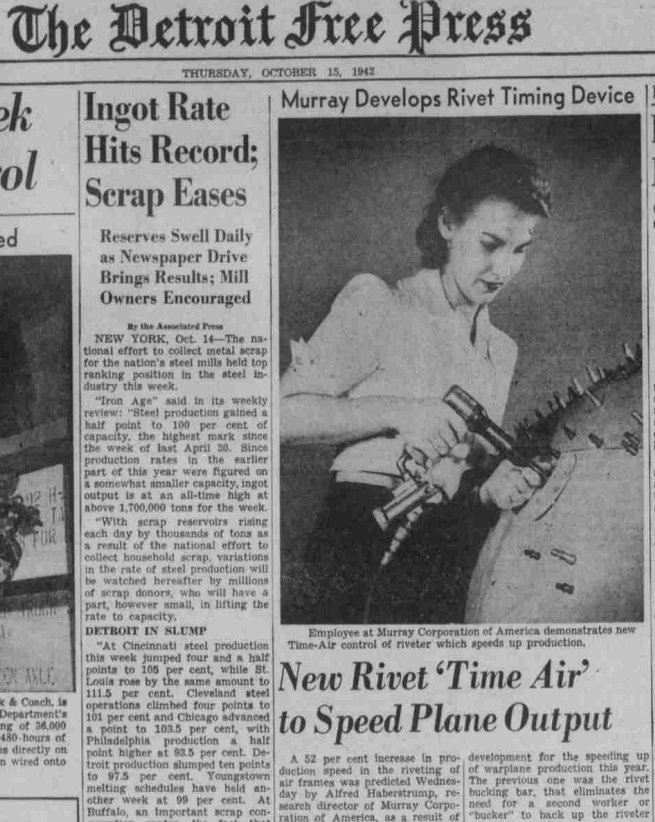

During World War II, the Murray Body Company completely halted civilian car production and transformed its 1600 Clay Street complex into a massive military powerhouse. Operating under the name Murray Corporation of America, Aircraft Division, the facility became a critical component of Detroit’s “Arsenal of Democracy”.

Pioneering Aircraft Mass Production (1941)
Before Murray's intervention, the aviation industry relied heavily on slow, meticulous hand-assembly.
The Automotive Transition: In January 1941, Murray secured a $26,000,000 contract from Douglas Aircraft.
An Industry First: Murray became the first company to successfully apply automotive mass-production stamping techniques to aircraft assembly. They re-tooled their giant steel hydraulic presses to shape complex, lightweight aluminum airframe parts with blistering speed.
The A-20 Havoc: Their first major task was building the massive inner wing sections for the Douglas A-20 Havoc light bomber. Each wing section required 5,400 individual parts and 55,000 rivets. Murray completed the entire contract ahead of schedule in 1942.
Building Wings for Legendary Bombers and Fighters
Following the success of the A-20 project, the U.S. military heavily leaned on Murray's workforce to scale up production for the nation's most critical aircraft. The Clay Street plant ran 24 hours a day to manufacture components for:
B-17 Flying Fortress: Murray built the outer wings, wing tips, and massive engine nacelles for the iconic B-17F heavy bomber under license for Douglas and Boeing.
B-29 Superfortress: The factory produced large airframe assemblies and wing components for the massive long-range bombers that operated in the Pacific Theater.
P-47 Thunderbolt: Murray stamped and assembled the rugged wings for the Republic P-47 Thunderbolt fighter-bomber.
B-24 Liberator: They utilized their heavy stamping plant to fabricate stainless steel subcomponents for the B-24 bombers being built at Henry Ford's nearby Willow Run assembly plant.
The Home Front Workforce
To keep up with this monumental demand, the facility underwent a massive labor boom. By 1944, the plant employed over 13,000 workers. Because a vast portion of Detroit's male workforce had been drafted into the military, the majority of the workers operating the heavy machinery and riveting the aircraft wings at the plant were women—cementing the Clay Street complex as a legendary real-life home for Detroit's iconic "Rosie the Riveter" workforce.
The factory's output was not limited strictly to aviation. Murray used its sheet-metal expertise to manufacture:
Heavy steel stampings for anti-aircraft searchlights used to defend cities and bases from nighttime air raids.
Specialized rudders for the Curtiss SB2C Helldiver dive bomber.
Frame and body components for heavy-duty military vehicles and transport trucks.

All photos of The Detroit Free Press provided by the Detroit Public Library online